How to Start a Freelance Grant Writing Business (Your Step-by-Step Guide)
Holly Rustick
After nearly 20 years as a freelance grant writer, I can confidently say that running your own freelance grant writing business is one of the best jobs in the world. It’s also one of the most rewarding, as you are helping people, causes, programs, and movements by connecting money to mission.
If you’re considering a career shift to freelance grant writing, you may have a lot of questions about how practical, lucrative, or hard it is. I’m here to answer those questions—and provide the practical resources you need to start your own business.
We’re going to cover everything from getting started to growing your business, including:
- What freelance grant writers do, how much they make, and the economic outlook for grant writing services
- What you need to get started in freelance grant writing
- How to structure your freelance grant writing business
- Getting your first clients as a freelance grant writer
- Must-haves for grant writing contracts and scopes of work
- How to set pricing for your freelance grant writing services
Now let’s get into the nitty gritty of everything you need to know about being a freelance grant writer, and if it’s for you (spoiler alert – it is!).
The Basics of Freelance Grant Writing
Grant writers prepare grant proposals for nonprofit organizations (and sometimes businesses) to secure funding for good causes. Grant writing can be done in two primary ways:
- Salaried or “in-house” grant writing, where you write grants for a single organization that pays your salary.
- Freelance grant writing, where you write grants for multiple clients through contracts
I’ve held both types of roles and can confidently say that freelance grant writing offers many benefits over a traditional salaried role—from higher income to flexible hours to freedom to choose who you work with. That’s why I created the Freelance Grant Writer Academy: to help more people experience the incredible benefits of starting a freelance grant writing business.
Freelance grant writing is fully remote with flexible hours
Grant writing as a freelancer has always been a virtual-friendly job.
You can work from home and set your own schedule. You can even decide how many hours per week or month you work (more on that later). Even back in 2007, while I was working on my Master’s degree in Belgium, I did all my freelance grant writing 100% remotely with flexible hours.
Your clients are paying you for a service—not for where you DO the service.
Freelance grant writers can earn a lot—and still work part-time
As a freelance grant writer, you can make as much as you want to.
Inside the Freelance Grant Writer Academy, we have folks like Grace, who was happy booking out just two clients on very part-time hours so she could stay home with her young kids. And she still made more money, $56,000, than in her former full-time job. Then we have people in the Academy like Payton, who are on track to make $300,000 in her second year of freelance grant writing because her reason is to create generational wealth in her family and break poverty cycles.
These are just solo freelance grant writers who do not have any staff in their business.
Inside the Grant Professional Mentorship, we coach a lot of grant writers who are building up grant writing agencies and hiring grant writers to work for them inside their businesses. Those grant agencies are earning multiple six figures, on average, as they are focused on scaling their businesses.
Really, the amount you can earn as a freelance grant writer can be scaled up or down based on 1) how many clients you want to have, 2) how much time you want to work, and 3) whether you have other team members or not.
Freelance grant writers can determine their own earning potential and schedule. That’s a pretty powerful combination.
You can become a freelance grant writer without prior experience
Yes, you can become a successful freelance grant writer without prior grant writing experience.
To get started, you will need two key things: training in grant writing and experience writing grants. For training, you can read books, try online courses, and attend in-person trainings or conferences. For experience, you can arrange short internships or volunteer periods with nonprofits you know. You could even negotiate with a nonprofit to pay for some grant training in exchange for your grant writing services. Just be sure to have some sort of reciprocity agreement if you offer your grant writing services for free when you are starting out.
To speed up your freelance grant writing career even more, you can check out programs like our Freelance Grant Writer Academy, where you can get both proven training and experience in the field. We actually have nonprofits pay for folks to join the Academy in exchange for volunteering at their nonprofit for three months or writing two grants.
Freelance grant writing is inspiring—you really can help change the world
As a freelance grant writer, you write grants for more than one organization. This is really exciting because it means you can use your grant writing skills to have a larger impact in the world.
In my own career as a freelance grant writer, I’ve been able to secure $46 million for organizations around the world. That’s bananas! Not many individuals can say they have been able to secure millions of dollars for causes they care about. That can be you, too.
In fact, inside our programs, we have coached 250 people to secure more than $225 million in grants for programs in just ONE year. This includes people who had never written a grant before, all the way to people who have seasoned businesses.
The ripple effect of grant writing is tremendous. The number of times that people have walked up to me and said, “Holly, I have a job because of the grant you wrote,” is amazing.
Compared to a salaried grant writing job, working with a variety of clients gives you more opportunities to secure more grants, which equals more impact. Gwen, a grant writer in the Academy, loves it when people come visit her in New Mexico, and while she’s driving them around town, she points out all the facilities that her grant writing has built.
Beyond your community, some freelance grant writers love to focus on a cause area instead and reach clients all around the nation or world.
You can literally decide what change you want to see in the world, and then specialize in those types of grants and work with organizations that have boots on the ground in those cause areas.
We’ve worked with a lot of people who create freelance grant writing businesses around cause areas like social justice movements, reproductive rights, technology, faith-based organizations, and environmental justice.
Plus, being that freelance grant writing is a virtual job, you can work with clients all over the globe. We see this all the time with folks serving education nonprofits in Nigeria, indigenous programs in Canada, and veteran programs in Idaho.
Running a freelance business is easier than ever
Freelance grant writing is a career (or side hustle) that you can literally do anywhere in the world, as long as you have internet access. With the COVID-19 pandemic, the infrastructure of digital work and grants has grown significantly. Being a freelance grant writer has never been so accessible and normalized with having tech like Zoom, Instrumentl, Google Docs, and AI.
Demand for freelance grant writers is growing
According to an article on LinkedIn, “Jobs on the Rise 2025: The 25 fastest-growing jobs in the U.S.”, being a grants consultant is #15.
Note, it doesn’t say ‘grant writer,’ but specifically ‘grants consultant’ (i.e., freelancer). Part of the reasoning behind this is that more and more telework, hybrid, or virtual jobs are desired, and being a grants consultant can be virtual or online.
I started out working in a virtual grant writing company in Northern Virginia in 2005. We worked in my boss's attic, repurposed as an office, and had clients all around the world. We still printed out and mailed in physical copies of grant applications back then, and the local FedEx employees knew me well. Then in 2007, I was a freelance grant writer in Belgium while I went full-time to university and got my Master’s degree.
This was before Zoom and before the working-at-home boom created by the COVID-19 pandemic.
Now that we have more infrastructure in place, freelancing has become much more normalized, especially with jobs that have always had the ability to be ‘virtual,’ like grant writing.
There is an appetite to hire freelance grant writers, as there are more than 1.9 million nonprofit organizations in the United States (2024) alone, and a majority of them (about 88 percent) have annual operating budgets of less than $500,000.
This means that for many nonprofit organizations, hiring a full-time staff grant writer might not be in the cards when they are wanting to get their foot in the door for grant funding.
Taken together, the number of nonprofit organizations that want to get started with grant writing, and the normalcy and infrastructure of freelancing, have dramatically increased freelance grant writing.

The market for freelance grant writers is still not saturated.
The number of nonprofit organizations being formed has continued to grow, and along with it, the number of freelance grant writers needed.
For larger nonprofits with budgets above $500,000 per year, there is still a need to hire freelance grant writers who can focus solely on growing the grant portfolio while keeping a leaner number of staff.
With the COVID-19 pandemic, many nonprofits dissolved their headquarters leases or downsized. When hiring freelance grant writers, they do not need to enlarge facilities or secure more office space. This is a huge cost savings as they can operate from smaller areas and save on lease costs, utility costs, computers, training, and more. Additionally, they do not need to pay fringe benefits such as taxes, health insurance, and workers’ compensation.
Even during the second term of the Trump Administration, there is still a growing need for freelance grant writers as nonprofits may be streamlining staff, need to write better grants, and have excellent grant and funding strategies.
As a freelance grant writer, you define what success looks like for you
Success and meaning as a freelance grant writer are really personal.
One of the first things that we have freelance grant writers do inside our programs is to define their ‘why’ of starting a business.
- Grace's reason was it was to have time at home with her two children.
- Joy's goal was a deeply personal, tragic experience of losing her father and realizing that time is short, so she wanted to take the risk of living her entrepreneurial dream.
- Jeremy's desire was to leave a toxic nonprofit job.
- Lina's dream was to transition into retirement by doing something with meaning for her community.
At the most fundamental level, success is really just opening a freelance grant writing business. It takes courage to do something new, and that should be celebrated!
Being an entrepreneur is one of the few things in life that will make you face yourself. Pricing your services brings up a slew of money trauma issues that you will need to face. Marketing your services makes you sell yourself and get out of your comfort zone.

I don’t think that being an entrepreneur changes you, but I do think it has you peel back layers to your more authentic self. And that is an amazing journey.
Another universal sign of ‘success’ as a freelance grant writer is when your business is operating and giving you the lifestyle that you originally desired when you started your business.
So now that Grace makes more money than she did in her 9-5 job, in half the hours, and is able to stay home with her kids, she feels and is successful.
Now that Joy is running a grant writing business, which has now reached the 6-figure annual income mark, and is able to work from home with her 3-year-old, she feels and is successful. She is living her dream and is proud of that.
Now that Jeremy is making more as a freelance grant writer than as an executive director at a nonprofit, and not working evenings and weekends, he is happy and successful.
Now that Lina has a roadmap and contacts for part-time work as a freelance grant writer before she retires, she is successful and feels financially secure.
Success doesn’t have to be earning $100K per year, although it might look like that for you.
What You Need to Start a Freelance Grant Writing Business
To become a successful freelance grant writer, you will need a computer, internet access, and two essential skills: 1) grant writing, and 2) business acumen.
You can learn both.
You don’t need a:
- grant writing degree or a business degree
- business loan
- 10,000 hours of experience
- A grant writing certification
- A business loan with a 50-page business plan to get approved.
All you need is internet access and a computer.
Folks inside the Academy, like Eowyn, Paulette, Christina, and Gabrielle, all won their first clients in the program, and Christina also got her first grant awarded.
What worked for them to go from zero experience to getting funded? Training, support, and community.
How to start if you have no grant writing experience
You do need to know how to write grants to be a freelance grant writer. However, you can also get clients while you learn how to write grants. For example, inside the Academy, we train people to write grants—and connect them with opportunities to gain experience as grant writers. Other types of grant training can be books, online courses, in-person training, etc.
How to start if you have grant writing experience, but no business experience

If you’re already an experienced grant writer, getting your first client or two usually doesn’t take much marketing, as everybody knows someone who needs a grant writer. Just mentioning what you do in conversation is like doing a magic trick. So be sure to carry around business cards with you, as you will surely hand out a lot.
But you still need to understand business acumen; i.e., how to price, how to market, how to sell, how to invoice, etc.
That is not an innate skill, but it can be learned. Not understanding these basic business skills can hold you back from growing your business.
This is because many grant writers aren’t sure how to sell their services.
Let’s face it. Pricing any kind of service (vs. a product) can feel a little ambiguous. Understanding the real value of your grant writing skills is important. Then you need to know how to put together your offers and how to run a sales call. None of this is difficult, but without a roadmap, it can feel overwhelming and take you longer than it needs to.
This is where a lot of people benefit from our programs: you gain expert guidance, coaching, and community as you learn to market your services and your value.
Here are some other great resources for building your freelance business acumen:
Freelance grant writing qualifications: what really matters
You do not need a grant writing certification to write grants. But some people are still interested in getting a grant writing certification due to external or internal reasons. We’ll examine both here so you can make an informed choice before starting your freelance grant writing business.
External considerations for a grant writing certification
A nonprofit might ask you if you have a grant writing certification during a Discovery Call. But what they are really asking is how experienced you are.
So if you do have a grant writing certification, then say, “YES!”
However, if you don’t have one, then instead let them know that there is no industry requirement for grant writers to have a certification. Because, well, there’s not.
Instead, let them know that you have written X # of grants, secured X dollars of funding, or any other details of your experience in grant writing.
Even if you did have the Grant Writing & Funding certification (yes, that’s a thing inside the Academy! wink-wink) or your Grant Professional Certification (the Academy also offers 31 education credits towards it) a nonprofit lead isn’t going to know how many hours of grant writing you have done, how long it took you to go through a course, etc.
They don’t know what the difference is between the Academy certification or the GPC.
So, even if you do not have a grant writing certification, you should still mention all the other cool things related to grants you have done.
If you are new to grant writing, this might be a reason you want some sort of certification, as you can eliminate a lot of OTHER questions that might come up if you say ‘no’ to this.
Externally, what having a grant writing certification will get you is:
- a nod of approval,
- a signature of experience (literally, put the logo in your email signature), and
- credibility.
You can put the name of your certification on your resume, website, LinkedIn profile, and business card! This lends to the external affirmation of your skills.
But once again, this is NOT required.
Internal considerations for a grant writing certification
The process of getting a grant writing certification can help increase your skills, knowledge, and confidence in writing grants.
If you are looking to improve any of the above, then you may consider going through a course, workshop, or program (like the Freelance Grant Writer Academy) to get a grant writing certification.
But there is one big disclaimer: a grant writing certification alone does not replace gaining experience. To have long-standing credibility and a reputation and to implement your learned skills, you need to practice writing grants.
So, yes, a grant writing certification can increase your resume and improve your skills, but actually going through the process of writing an entire grant template and getting feedback will make this skill real.
So, do you really need a grant writing certification? No.
However, a grant writing certification can be helpful in increasing credibility, knowledge, skills, and confidence. But you still will need to actually start writing grants.
How to Structure a Freelance Grant Writing Business
How you structure your freelance grant writing business has a lot to do with your goals. For example, do you want to work part-time (while earning a full-time income) or do you want to grow a multi-six-figure business with multiple team members?
The biggest considerations to get started will be admin/tax logistics, choosing a name, and setting income and hours goals.
Cover administrative logistics
Just like any business, a freelance grant writer needs to incorporate their business. The process will depend on where you live in the world.
The main different business incorporations in the United States include:
- Sole-Proprietorship
- Limited Liability Corporation (LLC)
- Sole Corporation
To figure out which type of incorporation is best for you, we recommend you talk to a lawyer.
You can also visit the U.S. Small Business Administration to see how you need to file in your state (they have an excellent drop-down list for all states and U.S. territories with the contact information for where you form a business).
Overall, forming a business in the United States is a pretty straightforward process. The main pieces to file your business are:
- Register your business name (it cannot be the same as another business name in your state)
- Have an EIN number and Articles of Incorporation
- Have a business location (address)
- Document ownership information/structure
- Provide Registered Agent information
This can feel overwhelming at first, so you can also hire a law firm or accounting firm to file your business documents for you.
What should you name your grant writing business?
A question I often get, which can paralyze many people from starting a business, is whether they should use their own name for their business or brand it with a general name.
My philosophy on this is that it really doesn’t matter. But there are some considerations that I have learned.
I would recommend that you do not create a whimsical name for your business that doesn’t make sense. For example, the first name of my company was WEGO Consulting. It was ‘cute’ because it was an acronym that stood for Writing, Editing, Grants, and Organizational Development (yes, we left out the D as that would have been too narcissistic—wink-wink).
Here’s the thing. Nobody was googling the word “WEGO” when looking for grant writing. When my logo was on something, nobody knew what it meant, except for me. That’s not the best marketing strategy.
I then changed my brand name to Grant Writing & Funding. And guess what? People actually Google that, and when I introduce my business name, it’s very clear what we do.
However, I also don’t mind folks using their own names for their business name. But I would recommend making it a little niche. For example, instead of just using Holly Rustick Consulting, what about Holly Rustick Grant Consulting?
A good reason for using your name and a niche description is that, most likely, nobody else will be using this name in your state (remember, you can’t have the same business name as someone else).
However, if you want your business to feel bigger than just you, or to grow at some point, you may choose not to use your name and have a broader brand name.

Full-time vs part-time vs side hustle for freelance grant writing
One major benefit of starting a freelance grant writing business is that you get to choose your schedule and workload.
Some people start writing grants freelance as a side hustle–dipping their toes into freelancing while still holding a salaried job.
Other people jump feet-first into freelance grant writing as their primary career. I’ve worked with people who start grant writing after being laid off, fired, or having to quit due to health, burnout, or family reasons.
No matter why you start freelance grant writing, you can work part-time hours and earn good money.
Some grant writers only want one or two clients and work around 20-30 hours per month for some additional money. This is perfect if you are:
- A stay-at-home parent who is taking care of little ones
- A retiree who wants to do a bit of work and earn income
- Someone who is taking care of family members with health issues or elderly relatives
- If you have a chronic illness or health condition and need a good income on limited hours
- and more
I have literally worked with hundreds of people from all walks of life to help them start freelance grant writing businesses.
Grant writing is a technical and professional skill, which means you can charge professional-level pricing. Just one client can easily bring in $3,000 per month at 20 hours per month.
With just four clients, working on part-time hours, you could make the (not-so) elusive six-figure income. We see this all the time in the Academy, with people quitting their full-time jobs within months because they are able to build out their grant writing businesses with just a few clients and replace their full-time income with part-time hours.
This might sound too good to be true, but it’s something that happens a lot. But if you are giving deep discounts or don’t understand how to put together services, it might take you longer to create a good revenue.
Choose the grant services you will provide
As a freelance grant writer, it is important to understand the specific grant writing services you will offer clients. You may think that all freelance grant writers offer the same services, but they do not.
Some service options include:
- Grant preparedness for $XXXX
- Writing 12-15 foundation grants per year for $XXXXX
- Creating a Master Grant Application for $XXXX
- Finding Grant Prospects for $XXXXX
- Writing Federal Grants for $XXX
When you understand what types of nonprofits or organizations you want to serve, you can establish clear packages or retainers to offer them.
Even though each nonprofit will be unique, the methodology and processes of what you offer can be rinse and repeat.
Setting up these systems and being clear on who you serve will enable you to work fewer hours with high results.
For example, you may have a 12-month retainer offer at $3,000 per month, where you write 12-15 foundation grants for the year. This might only take you 20 hours per month of your time because of your systems.
Nonprofits love these types of retainers because they are affordable, and you are just focused on writing grants for them.
In one year, that would be $36,000 for one client at only 20 hours of your time per month!
You can easily take on four of these retainer clients and would still be working part-time at 80 hours per month (or 20 hours per week). That would equal $144,000 for the year.
Read on to learn how to determine pricing for your service offerings and how to market them!
Getting Your First Clients as a Freelance Grant Writer
A lot of people get nervous when it comes to finding their first freelance grant writing clients. The good news is that your first grant writing clients can be secured through a variety of ways. It doesn’t have to feel hard, and you don’t need many clients at all to get things rolling.
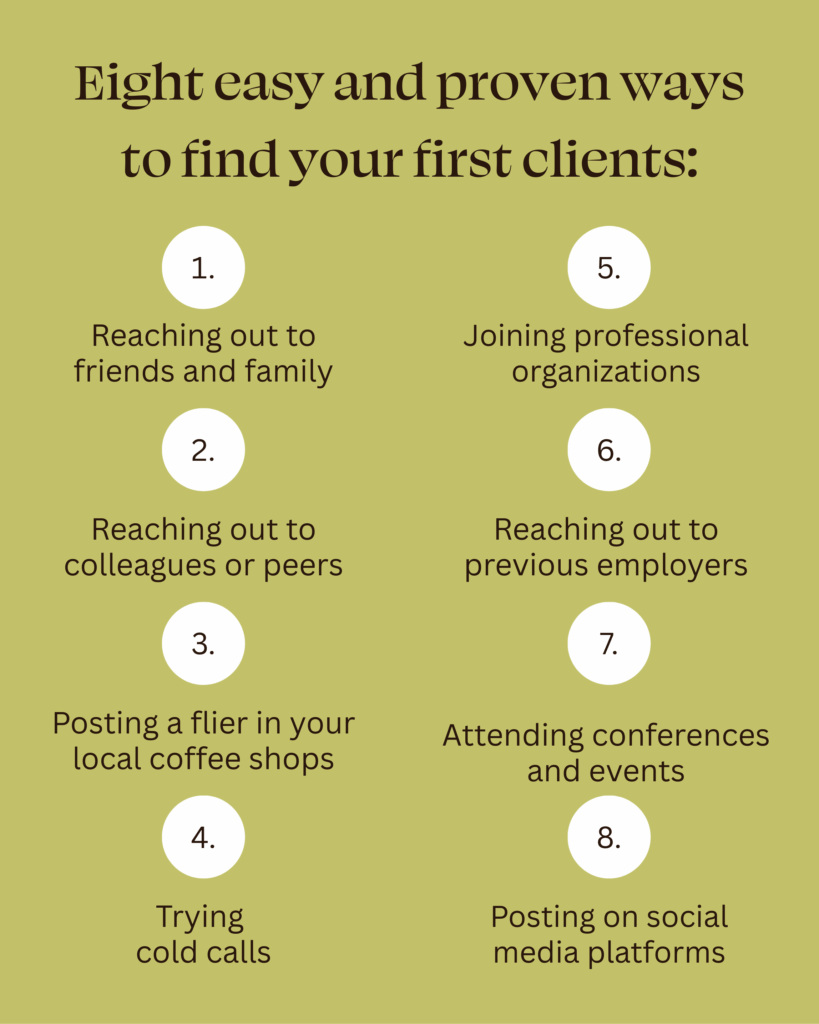
Here are eight easy and proven ways to find your first clients:
- Reaching out to friends and family. Everybody knows somebody who works at a nonprofit, sits on a board of directors, or has heard about grants. Letting your friends and family know that you are now writing grants for organizations and asking them to send folks your way is a low lift. Plus, they want to help you out!
- Reaching out to colleagues or peers. You may already work inside a nonprofit organization, university, school, or place where folks may be even more familiar with grants than your friends or family. Letting your network know that you are available is easy and often yields quick results!
- Reaching out to previous employers (especially if they are nonprofits) is another easy way to get some referrals. In fact, the number one way freelance grant writers get clients is through referrals.
- Reaching out to other professionals or joining professional organizations. It is highly recommended to join a Chamber of Commerce or other professional association to get to know other professionals. I love reaching out to my contacts in these associations who are lawyers, bookkeepers, marketers, etc., and meeting up for a ‘network referral call,’ asking if they have any referrals, and also giving some referrals to them! This is a win-win! They will know organizations that may need grant writing, and you may know folks (or yourself!) who need their services.
- Attending conferences and events. It is a great idea to go to conferences where the decision-makers at your ideal client organizations go. For example, Brian, who I work with inside our Mentorship program, serves nonprofits that help during environmental disasters. He attends environmental disaster conferences! That’s where his clients go, so that’s where he goes.
- Trying cold calls. Some people also just reach out to nonprofits or organizations and see if they would be interested in their services! This is absolutely fine, although it can feel a little intimidating. That’s why we created an entire campaign around this inside the Academy so you don’t feel so sleazy but can utilize our Ethical Nonprofit Sales System!
- Posting a flier in your local coffee shops, libraries, community centers, etc. This is important to start building up local recognition and for people to start seeing you in different places.
- Posting on social media platforms. Some grant writers love to have Facebook, LinkedIn profiles, or other social media, and get clients through direct messages or just by posting.
Grant Writing Contracts and Scopes of Work: The Essentials
Contracts are important to have with your grant writing services. This is where both your client and you agree to specific terms and conditions. You will want to ensure you have all the expectations from both parties clearly stipulated, including: when work will get done, policies, cancellation clauses, payment terms, and scope of work.
I find contracts to be liberating, when done correctly, because they create your terms as a freelancer. Sometimes clients just forget what these terms are, so you need to remind them gently and neutrally. Just by doing that, you can create those sought-after boundaries and ensure you are not being treated as an employee.
For example, if you have a policy that you will reply to clients within 24 hours Monday through Friday, don’t feel bad if they call you Saturday morning and you don’t answer until Monday. That is in your contract.
If your scope of work includes one meeting per month and writing 1-3 grants, you can say no to grant number four or other work, as it would fall outside your scope of work.
Inside the Academy, we have a sample contract with policies like grant lead writing time, communication, and more. Our students LOVE it so much because it creates policies that they can lean on for healthy boundaries.
Here are just a few of our favorite policies to include inside contracts:
“We do not guarantee funding of grants”
This is an important policy because you can never guarantee a grant will be funded. Funding decisions are out of your control because you are not the funding agency!
But so many clients may think that just because they hired you that your Return on Investment (ROI) is the grants getting awarded. Your ROI is actually more rooted in the work that you complete in writing the grants, helping them get clearer on their programs, and helping find new potential funders and partners.
Always specify payment terms in contracts
You must have payment terms within your contracts, such as 1) when you get paid, 2) how you get paid, and 3) what happens if there are late payments.
When you get paid as a freelance grant writer is important. You do not want to get paid when work is completed. You need to get paid before work begins (or at least receive a portion of the payment).
Too many new grant writers come into the Academy and say they are frustrated because their clients haven’t paid. When I ask what their payment terms are, they say they get paid upon completion of writing the grant.
To mitigate the issue of late payments and not getting paid, you have a payment upon signing the contract to get you started.
How you get paid is also important. Be very clear on how you collect payment. What we recommend is that you set it up so you can automatically bill your clients for recurring payments on a credit card. This also mitigates late payments or having to keep following up on payments.
Late fees or Stop Work. You can also include late fees if they are paying you in installments (but remember to get your first payment when they sign the contract and before you start work). Or some folks just say they will stop work (which may halt grant writing!) if they do not get their subsequent payment.
Include grant lead times in your contracts
We highly recommend including your grant lead time on grants. For example, what is your policy around how much lead time you need on writing specific grants?
This might look like:
3-4 weeks lead time to write a foundation grant
4-6 weeks lead time to write a state grant
6-8 weeks lead time to write a federal grant
Without this lead time, your clients will throw grants at you at the last minute. You will be setting up your plans for the weekend, and they will email you a grant due the next week. Without this policy, you will feel bad (because it usually is a good fit!) and want to please your clients, so you will end up working all weekend and ditching your self-care plans.
This will lead to a poorly written grant (because let’s face it, you were up to 2 am Friday and Saturday night without all the right research) and won’t create good boundaries.
Lead time is important for a professional to write high-quality grants and schedule time appropriately. If you do take a ‘rush’ grant, make sure you charge at least double the cost and don’t take away from your self-care.
Get specific on scope of work in grant writing contracts
In your contracts, list out exactly what you will do and by when. Sure, you can keep things general, like 2-3 funding assets per month (which could be a two-page letter of inquiry for a foundation grant and writing a newsletter), but list out what all these funding assets could include.
Do not over-deliver on any extra items outside of your scope of work for your contract. In this way, it is very clear what you have both agreed upon for the scope of work and pricing.
There are definitely more items to include in your contracts, but these are some of the Academy members’ favorites!
How to Set Your Prices as a Freelance Grant Writer
As I’ve been sharing in this article, as a freelance grant writer, you can make as much as you want to. I work with folks who are happy booking out just two clients on very part-time hours—and still earning $56,000—and with grant writers who are earning multi-six-figure incomes. It’s all up to you, your goals, and the life you want to lead.
But regardless of your goals, the key to achieving them is properly pricing and valuing your own services and work. This can be surprisingly hard!
So let’s cover the basics on how to price and package your grant writing services.
Do not charge on commission for grant writing
First off, let’s explain how you CANNOT and should not price.
You cannot work on commission to charge for your grant writing services. For example, a nonprofit asks you to write the grant, and if the grant gets awarded, then they will pay you a certain percentage from the awarded grant.
This is a hard no.
For one thing, charging on commission is against grant writing best practices.
It could also undermine the grant’s chance of success. The vast majority of grant budgets do not allow funding for ‘pre-award’ work. Only work that will be carried out after the grant contract is signed is approved to be paid from the grant.
How do you charge if you cannot write a grant on commission?
Consider the three core pricing models
You can price your grant writing services by hours, in a time-limited package, or on a monthly retainer. Let’s look at the pros and cons of each.
Hourly pricing for grant writing services
Some grant writers prefer to price by the hour. This can be useful when you are new to grant writing, as you may not be sure how long it will take you to write the grant or complete the scope of work.
However, your clients will still want an estimated time of how many hours it will take you to write a grant.
After working with freelance grant writers for more than a decade, here are some estimates of time:
- Foundation grants: An average of 10-20 hours per grant
- State grants: An average of 40-65 hours per grant
- Federal grants: An average of 80-100 hours per grant
This is just an estimate and does not include nuanced grants, your level of experience, or your knowledge of certain grants.
Once you work with a nonprofit client on an ongoing basis, your grant writing time will start to reduce because you have previously written grants to pull existing language from, and you know the programs in more depth.
When you are starting, it may take you a lot longer to write grants, as well.
In any case, we strongly recommend that you track your time. This will give you data and estimations for your pricing.
Pros of Hourly Pricing:
- When you are new to grant writing, you will be paid for all the time you spend writing a grant.
Cons of Hourly Pricing:
- The more experience you have or the longer you work with an organization, the fewer hours you will work, so your ability to earn more reduces as your experience increases.
- If you run out of agreed-upon hours and still need to finish a grant, then you need to request more hours. It’s then up to the nonprofit to agree to pay more hours or not.
Package pricing for grant writing services
When you charge a package price, you are delivering a specific scope of work within a specific timeline.
For example, a student in the Freelance Grant Writer Academy, Christina, helps nonprofit organizations with under $100,000 annual operating budgets get grant-ready through a Grant Readiness Package.
Inside the Grant Readiness Package, she includes the following scope of work:
- Onboarding Document Checklist
- Nonprofit Wellness Audit Report and Score
- Action Plan Templates
She turns this around in 4-6 weeks and charges an upfront flat fee of $600. Christina does not include any grant writing in this package. She only helps nonprofits get grant-ready.
Pros of Package Pricing:
- Packages are a great entry point for clients to ‘try you out’ and for you to get to know them.
- Packages can include items other than grant writing (like grant readiness or grant prospecting that prepare clients to sign up for your grant writing services).
Cons of Package Pricing:
- If you include grant writing in your packages, it may not be a long enough duration of time to meet grant writing deadlines.
- You are constantly pitching services because you only get paid when packages are signed.
Retainer pricing for grant writing services
Most of the grant writers I work with love retainer pricing. Why? Because you can work with fewer clients, for a longer period of time, and get them more results. Plus, you have consistent cash flow projections vs. hourly pricing or package pricing.
For example, inside the Freelance Grant Writer Academy, Gwen writes grants for local municipalities. Therefore, she mainly writes federal and state grants and has them on 12-month retainers.
Inside her scope of work, it looks something like:
- Onboarding Meeting – Month One
- Monthly Grant Strategy Meetings – Monthly
- Attending Grant Webinars – When Needed
- Meeting with Partners and Stakeholders – Monthly
- Writing X Federal Grants per Year – Throughout the Year
- Writing X State Grants per Year – Throughout the Year
- Grant Funding Prospecting – Throughout the Year
Notice how clear the scope of work and deliverables are. It does not include ‘All Duties as Necessary’ or other items that are not her specialty.
Based on the number of grants she writes, she will charge a certain amount per month that does not change. This could be anywhere from $4,000 to $7,000 per month. Once the number and type of grants are determined, she sets the same rate every month.
She knows what she will get paid a set amount each month for the year, and the municipalities know how much to budget for her fee each month.
Pros of Retainer Pricing:
- Nonprofits can set a budget every month and know the scope of work.
- Freelance grant writers can have cash flow every month and project what they will earn each month.
- Freelance grant writers can create consistent schedules and know how many clients they need based on how much time they have. Any hourly or project-based work can be random for one-off grants or projects.
- Freelance grant writers do not have to do as much marketing.
Cons of Retainer Pricing:
- When starting out as a grant writer, you may be unsure of all deliverables to include.
You can use multiple pricing models in your business
Some freelance grant writers have a combination of hourly, packages, and retainers. This could look like:
- Hourly: Reviewing a Grant – Charge 10 hours of time at $90 per hour to equal $900.
- Package: Grant Readiness Package. Get your nonprofit grant ready in 4-6 weeks with a Nonprofit Wellness Audit at $1,200.
- Retainer: Be a client’s go-to grant writer, and write 10-12 foundation grants, identify 15-20 funding prospects, and meet monthly for 12 months at $2,500 per month.
Regardless of the pricing model, always be sure to understand clients’ goals and expected results, and to lay out clear expectations from the start.
Ready to Start Your Freelance Grant Writing Business?
We have covered a LOT in this article. The bottom line is that starting your own freelance grant writing business is one of the best moves you can make for yourself and your career. Especially today, full-time salaried jobs don’t provide the financial stability they once did. With your own grant writing business, you’ll have multiple clients and control of your time, your income, and your financial future.
If you’re ready to get started, our Freelance Grant Writer Academy is one of the fastest and most reliable ways to turn your goals into reality.
May 29, 2025
Work from home and have a massive impact on your community. Set up a grant writing business so you can start getting paid to write grants.
OUR SPICY BELIEF IS THAT ALL GRANT WRITERS SHOULD START A BUSINESS, EVEN IF IT’S PART-TIME.
GET ACCESS NOW
You will get the grant writing system that has helped Holly secure more than $25 million in grant funding and students earn more than $100,000,000 in funding for nonprofits around the world!